Calculate the Binomial Probability Mass Function (PMF) online using our simple and accurate calculator. Get instant results with clear explanations.
Binomial PMF Calculator
View Also – Binomial distribution calculator
Binomial PMF Calculator – Step-by-Step Probability Solver
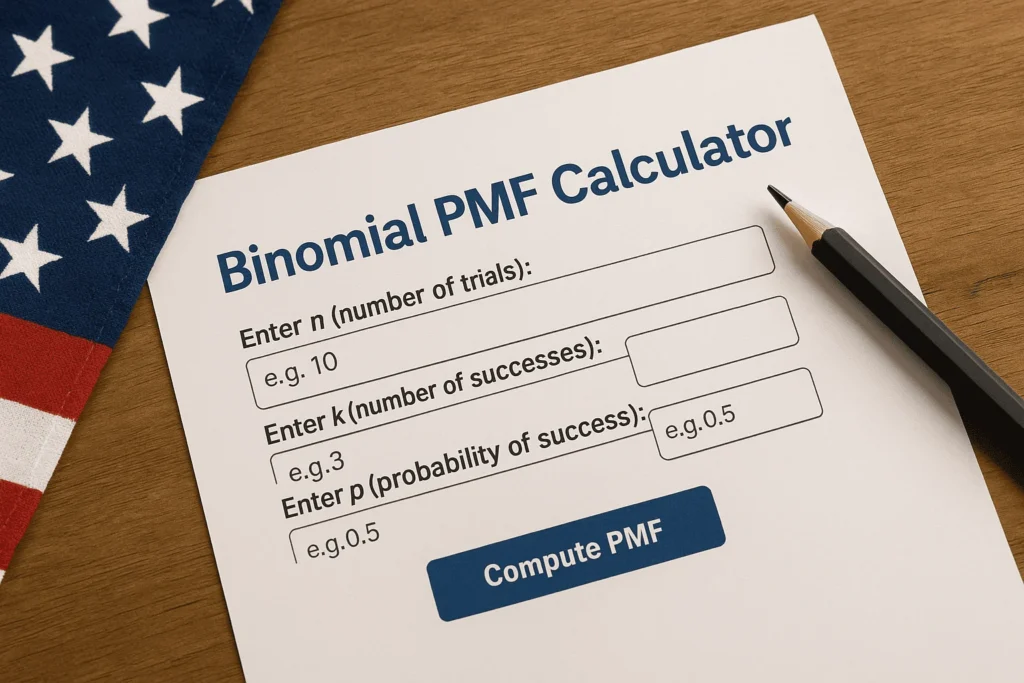
The Binomial PMF Calculator helps you calculate the exact probability of getting exactly k successes in n independent trials, where the probability of success in each trial is p. This tool is designed for students, teachers, and professionals who need accurate probability results along with a clear explanation of each step.
Whether you are preparing for exams, learning probability, or analyzing real-world data, this calculator makes binomial probability calculations simple and easy to understand.
How to Use the Binomial PMF Calculator
Using the Binomial PMF Calculator is straightforward. Follow the steps below to compute probabilities accurately.
Step-by-Step Instructions
1. Enter the Number of Trials (n)
The number of trials represents the total number of independent experiments or attempts.
For example, if you flip a coin 10 times, the value of n = 10.
2. Enter the Number of Successes (k)
This is the exact number of successful outcomes you want to calculate the probability for.
For example, if you want to find the probability of getting exactly 4 heads, then k = 4.
3. Enter the Probability of Success (p)
This value represents the probability of success in a single trial.
It must be a decimal number between 0 and 1.
Examples:
- For a fair coin, p = 0.5
- For a 30% success chance, p = 0.3
4. Click the “Compute PMF” Button
After entering all values, click the compute button.
The calculator will display:
- The final PMF value, which is the probability that X = k
- A detailed step-by-step solution using the binomial PMF formula
5. Read the Result and Explanation
The output includes:
- The binomial formula with substituted values
- Factorial calculations
- Powers of probabilities
- The final answer rounded to 8 decimal places
Example Calculation
Suppose you want to calculate the probability of getting exactly 5 successes in 12 trials, where the probability of success is 0.3.
You would enter:
- n = 12
- k = 5
- p = 0.3
After clicking Compute PMF, the calculator shows:
P(X = 5) ≈ 0.15841
Along with a full step-by-step mathematical explanation.
What Is the Binomial PMF?
The Binomial Probability Mass Function (PMF) gives the probability of observing exactly k successes in n independent trials, when each trial has the same probability of success p.
This model applies when:
- Each trial has only two outcomes (success or failure)
- All trials are independent
- The probability of success remains constant
For example, when flipping a coin multiple times, the binomial PMF helps calculate the probability of getting a specific number of heads.
What the Calculator Provides
After entering valid input values, the calculator displays:
- The final PMF result rounded to 8 decimal places
- A clear step-by-step breakdown of the calculation
- Well-formatted mathematical expressions for better understanding
This is especially useful for:
- AP Statistics students
- GCSE and A-Level Mathematics learners
- Probability and statistics courses
- Data science and machine learning basics
Applications of the Binomial PMF
The binomial distribution is commonly used in many practical situations, such as:
- Exam pass or fail probability
- Quality control and defect analysis
- Survey and market research
- Genetics and biological studies
- A/B testing and digital analytics
Input Validation and Error Handling
The calculator checks all inputs to ensure accuracy:
- All values must be valid numbers
- The condition 0 ≤ k ≤ n must be satisfied
- The probability p must lie between 0 and 1
- Clear error messages are shown for invalid input
Why Use This Binomial PMF Calculator?
This calculator is:
- Free and easy to use
- Fast and accurate
- Mobile and desktop friendly
- Ideal for exam preparation and classroom learning
- Designed to help users understand the calculation process, not just the final answer
FAQs – Binomial PMF Calculator
What happens if k is greater than n?
This input is invalid because the number of successes cannot exceed the total number of trials.
Can the probability p be less than 0 or greater than 1?
No. Probability values must always be between 0 and 1.
How are factorials calculated?
The calculator uses an optimized JavaScript loop-based method to calculate factorials efficiently and accurately.
Is this calculator accurate?
Yes. The calculator follows the exact binomial PMF formula and provides results accurate up to 8 decimal places.
Conclusion
The Binomial PMF Calculator is a reliable and user-friendly tool for calculating exact probabilities in binomial distributions. With its clean interface and step-by-step explanations, it is suitable for students, teachers, researchers, and anyone learning probability concepts.
Use this calculator to solve probability problems quickly and gain a deeper understanding of binomial distributions.
Disclaimer
This calculator is intended for educational purposes only. For professional or critical applications, always verify results using certified statistical software or academic tools.
1 thought on “Binomial PMF Calculator – Calculate Probability Mass Function Online”