Use our Conditional Probability Calculator to solve P(A|B) with formulas, step-by-step explanations, tables, and real-world examples for students.
Conditional Probability Calculator
View Also – Binomial distribution calculator
Welcome To Our Conditional Probability Calculator
Welcome to our Conditional Probability Calculator, a practical tool designed to help you calculate P(A | B) easily and accurately. This calculator is ideal for students, learners, and professionals who want clear formulas, step-by-step explanations, and real examples for both independent and dependent events.
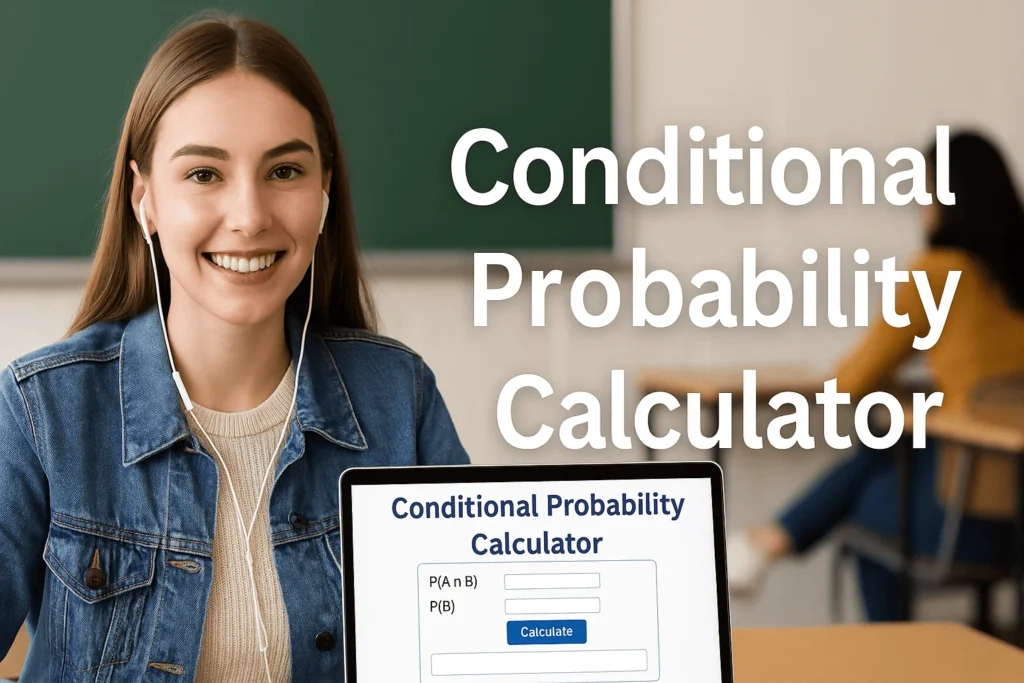
Whether you are studying probability, statistics, or data science, this calculator simplifies conditional probability problems and helps you avoid manual calculation errors.
Conditional Probability Calculator
The Conditional Probability Calculator allows you to compute the probability of event A occurring given that event B has already occurred.
You simply need to enter:
- Probability of intersection P(A ∩ B)
- Probability of event P(B)
Click Compute, and the calculator instantly provides the result along with a clear explanation.
Related Calculators
You may also find these calculators useful:
- Binomial Distribution Calculator
- Binomial Probability Calculator
- Binomial Expansion Calculator
- Z Score to Probability Calculator
Conditional Probability Calculator – With Steps, Table, and Examples
Understanding conditional probability is essential in statistics, probability theory, and data science. When one event depends on another, calculations can become confusing. This calculator helps you solve conditional probability problems clearly, even when working with tables, diagrams, or multiple events.
What Is Conditional Probability?
Conditional probability is the probability that one event occurs given that another event has already occurred. It is written as:
P(A | B) = P(A ∩ B) / P(B)
This formula applies when P(B) ≠ 0.
Why Use a Conditional Probability Calculator?
Using a conditional probability calculator with steps:
- Saves time on complex calculations
- Reduces manual errors
- Handles dependent and independent events
- Works with decimals, fractions, and percentages
- Supports tables, diagrams, and multiple events
How to Use the Conditional Probability Calculator
Follow these steps to calculate conditional probability correctly.
1. Choose the Input Type
You can work with:
- Decimal probabilities
- Fractions
- Percentages
- Tables or diagrams
2. Enter Known Values
Enter the joint probability P(A ∩ B) and the probability P(B).
3. Identify Event Dependency
Decide whether events are independent or dependent.
4. Click “Calculate”
The calculator computes P(A | B) instantly.
5. View the Result
You’ll see the final probability along with a step-by-step explanation.
Find Conditional Probability Calculator for Different Use Cases
Conditional probability calculators can be applied to many different problem types.
Conditional Probability Calculator Using Fractions
If probabilities are given as fractions, simply convert or enter them directly. The calculator handles fraction-based inputs accurately.
Conditional Probability Calculator for Dice
Example:
What is the probability of rolling a 4 on the second roll, given the first roll was even?
The calculator evaluates outcomes and provides the correct conditional probability.
Multiple Conditional Probability Calculator
For three or more events, conditional probability follows:
P(A ∩ B ∩ C) = P(A) × P(B | A) × P(C | A ∩ B)
This is useful in genetics, disease modeling, and risk analysis.
Conditional Probability Calculator Table
Tables are commonly used in exams and surveys.
Example table:
- Event A and B
- Event A and not B
- Not A and B
- Not A and not B
Using a table-based calculator, you can easily find:
- P(A | B)
- P(B | A)
- P(A ∩ B)
Visual Methods to Calculate Conditional Probability
Conditional Probability Calculator Tree Diagram
Tree diagrams show sequences of events and branching outcomes. The calculator traces each path and computes probabilities accurately.
Venn Diagram Conditional Probability Calculator
Venn diagrams visualize overlapping events. The calculator uses intersections to find conditional probabilities for dependent events.
Intersection and Conditional Probability Calculator
To calculate joint probability, the calculator applies:
P(A ∩ B) = P(A | B) × P(B)
This is useful when conditional values are already known.
Independence and Conditional Probability Calculator
For independent events:
P(A | B) = P(A)
The calculator can check whether events are independent by comparing conditional and marginal probabilities.
Bayesian Network Conditional Probability Calculator
Bayesian networks are used when multiple probabilities depend on one another.
This calculator supports:
- Prior probabilities
- Conditional probability tables
- Event dependencies
Common uses include:
- Medical diagnosis
- Machine learning
- Risk assessment
Conditional Probability Calculator TI-84
On a TI-84 calculator:
- Access probability tools via the DISTR menu
- Enter formulas manually or use custom programs
However, web-based calculators are easier and faster for most users.
Common Mistakes When Using a Conditional Probability Calculator
- Reversing conditions, such as calculating P(B | A) instead of P(A | B)
- Forgetting that P(B) must not be zero
- Treating dependent events as independent
- Misreading table values or percentages
Always double-check inputs before calculating.
Real-World Applications of Conditional Probability
Conditional probability is widely used in:
- Healthcare (disease probability given symptoms)
- Finance (risk given market conditions)
- Education (pass rates based on preparation)
- Manufacturing (failure probability given usage data)
FAQ – Conditional Probability Calculator
What is a conditional probability calculator used for?
It calculates the probability of one event occurring given that another event has already happened.
Can this calculator handle multiple events?
Yes, it supports problems involving three or more conditional events.
Does it support tables and Venn diagrams?
Yes, many explanations and formats are supported for visual learning.
Can I use it for fractions, dice, or cards?
Yes, the calculator works with fractions, percentages, and common probability experiments.
Is it available for Excel or TI-84?
You can replicate it in Excel or on a TI-84, but online calculators are faster and easier.
Conclusion
The Conditional Probability Calculator is a powerful and easy-to-use tool for solving probability problems involving dependent events. With formulas, step-by-step explanations, tables, and visual methods, it helps students and professionals calculate probabilities accurately and confidently.
Use this calculator to simplify conditional probability problems and deepen your understanding of probability concepts.
Disclaimer
This Conditional Probability Calculator is provided for educational and informational purposes only. While it follows standard mathematical formulas, results should be verified independently for academic, professional, or critical decision-making purposes.